|
editorial |
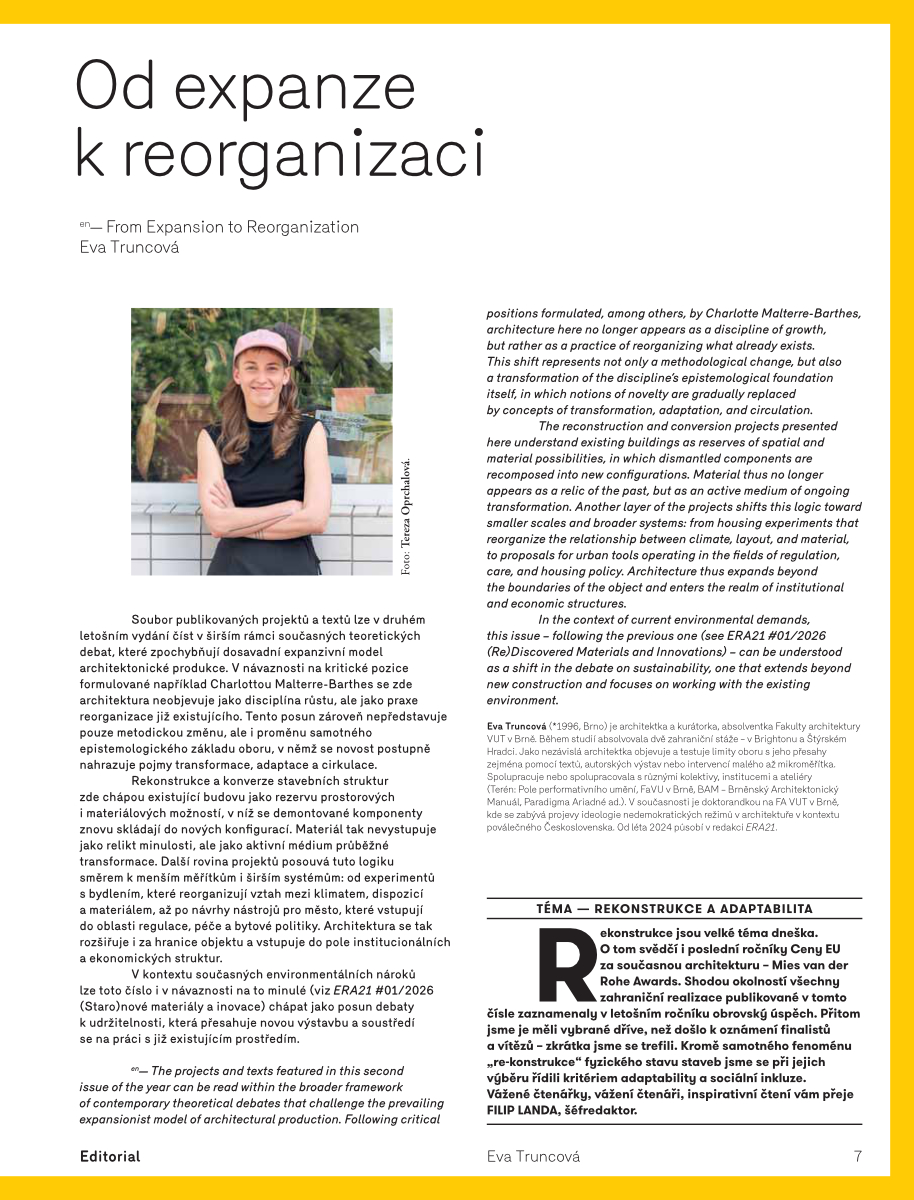
From Expansion to Reorganization » The projects and texts featured in this second issue of the year can be read within the broader framework of contemporary theoretical debates that challenge the prevailing expansionist model of architectural production. Following critical positions formulated, among others, by Charlotte Malterre-Barthes, architecture here no longer appears as a discipline of growth, but rather as a practice of reorganizing what already exists. This shift represents not only a methodological change, but also a transformation of the discipline’s epistemological foundation itself, in which notions of novelty are gradually replaced by concepts of transformation, adaptation, and circulation. |
| news | ||
|
completed project |
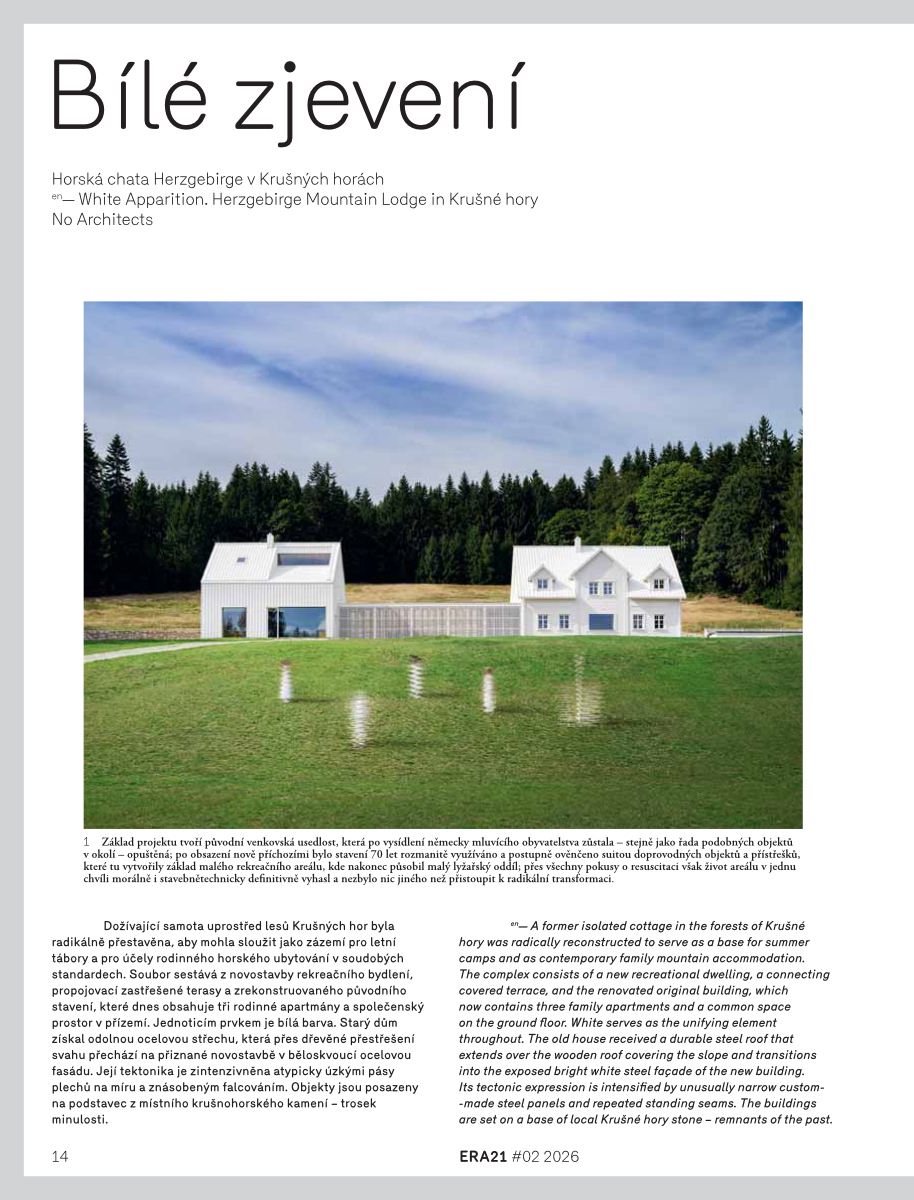
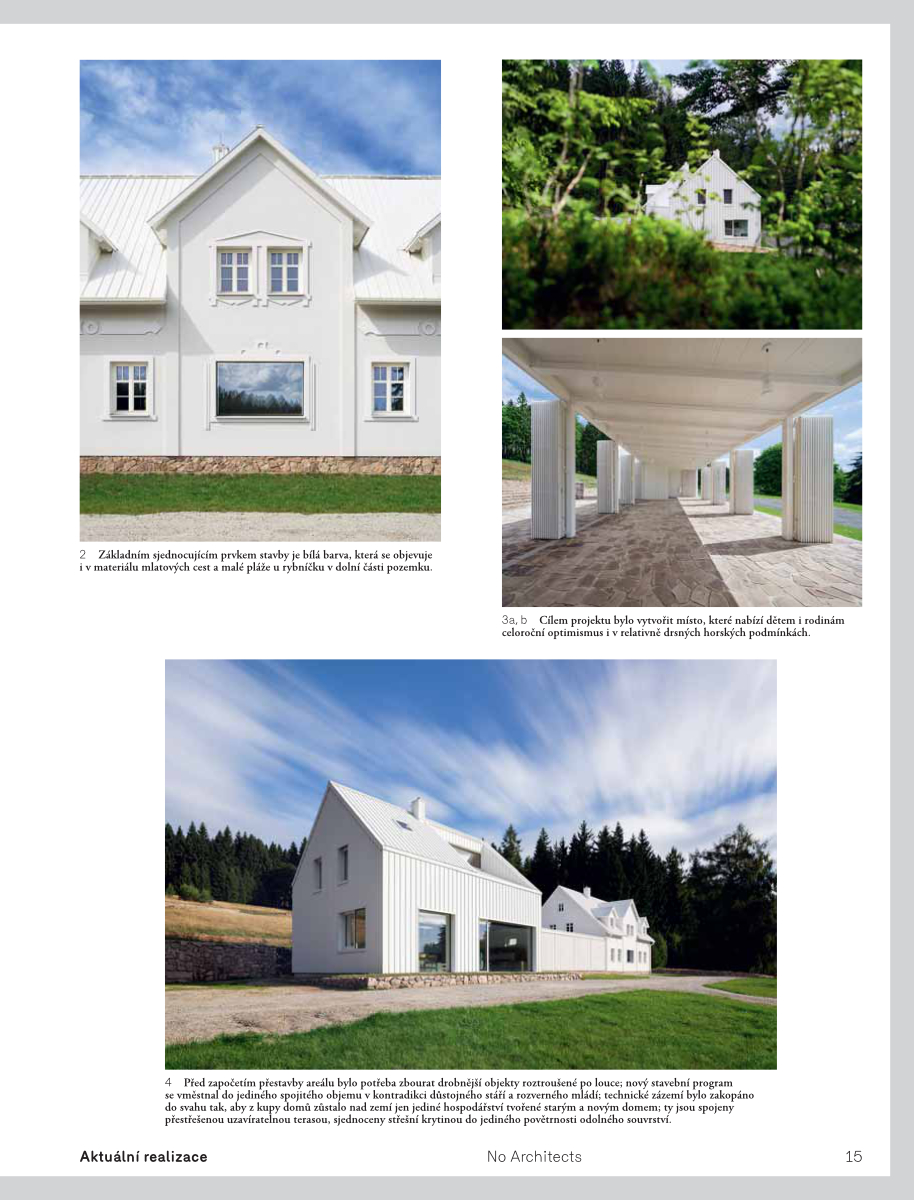
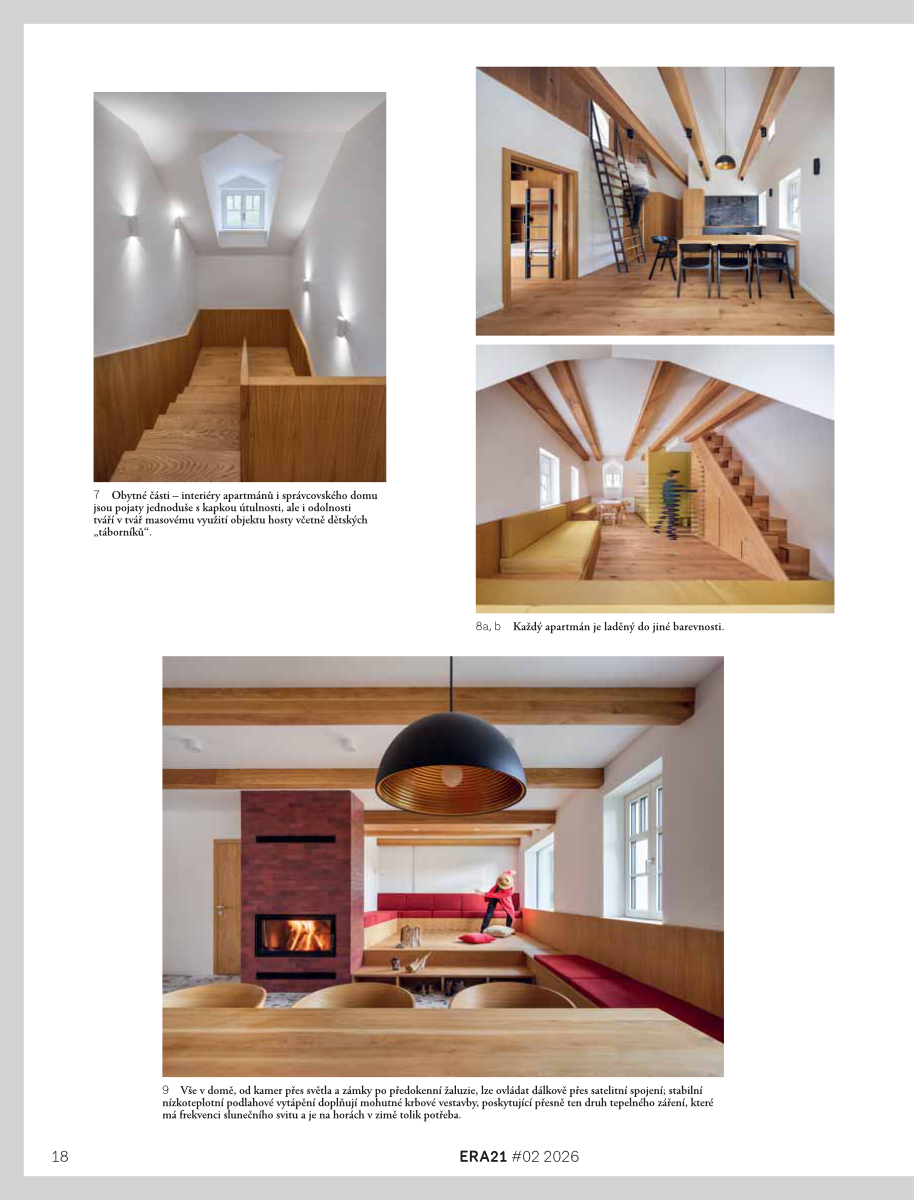
White Apparition. Herzgebirge Mountain Lodge in Krušné hory » A former isolated cottage in the forests of Krušné hory was radically reconstructed to serve as a base for summer camps and as contemporary family mountain accommodation. The complex consists of a new recreational dwelling, a connecting covered terrace, and the renovated original building, which now contains three family apartments and a common space on the ground floor. White serves as the unifying element throughout. The old house received a durable steel roof that extends over the wooden roof covering the slope and transitions into the exposed bright white steel façade of the new building. Its tectonic expression is intensified by unusually narrow custom- -made steel panels and repeated standing seams. The buildings are set on a base of local Krušné hory stone – remnants of the past. |
| intro |
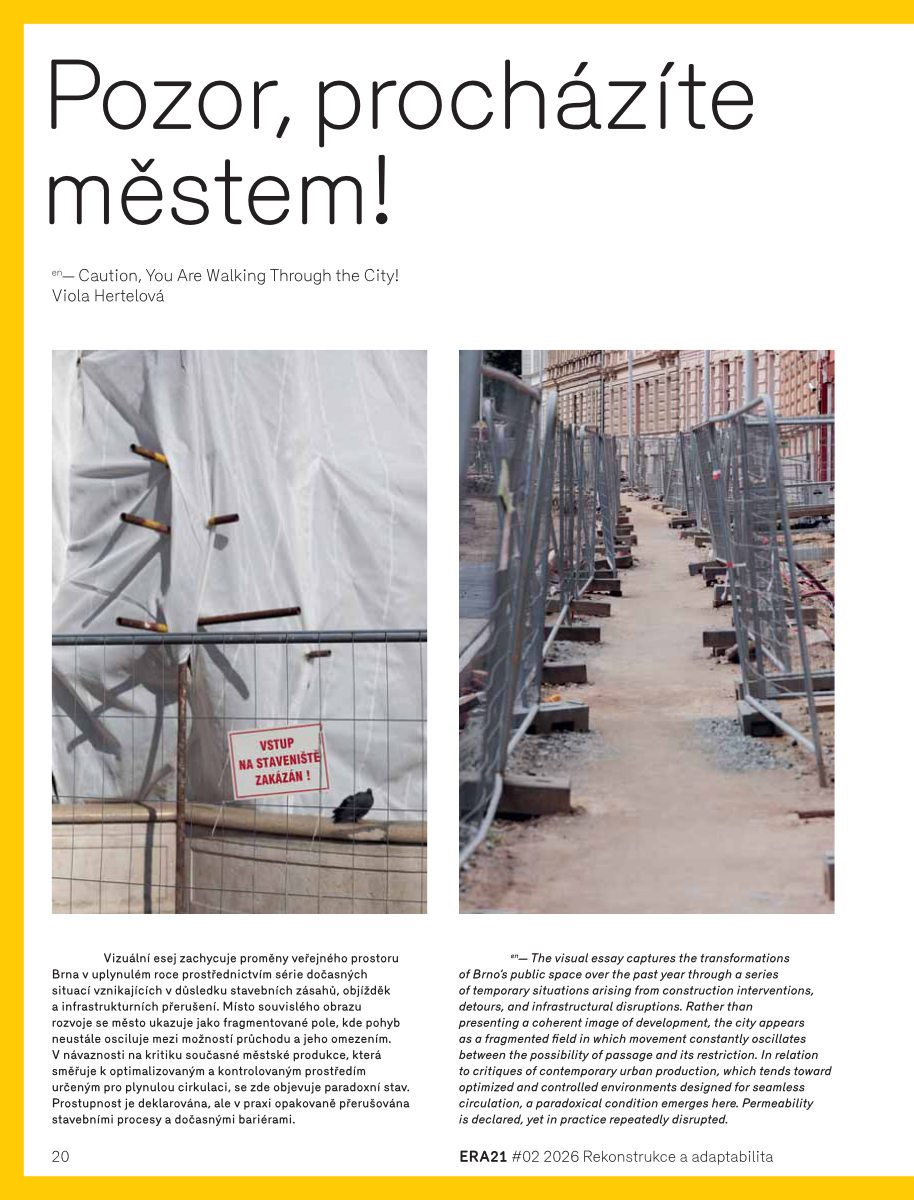
Caution, You Are Walking Through the City! » The visual essay captures the transformations of Brno’s public space over the past year through a series of temporary situations arising from construction interventions, detours, and infrastructural disruptions. Rather than presenting a coherent image of development, the city appears as a fragmented field in which movement constantly oscillates between the possibility of passage and its restriction. In relation to critiques of contemporary urban production, which tends toward optimized and controlled environments designed for seamless circulation, a paradoxical condition emerges here. Permeability is declared, yet in practice repeatedly disrupted. |
|
|
interview |
The Journey is the True Destination. Pavel Prouza Interviewed by Filip Landa » Nineteen years ago, architect Pavel Prouza embarked on a bold journey when he acquired a partially ruined steam-powered brewery in Lobeč and began its restoration. Later, his attention turned to valuable early-20th-century villas in Mělník designed by architect Bohumil Hübschmann. In the interview, he describes the history of the properties under his care, as well as the many challenges accompanying their rehabilitation, with his characteristic enthusiasm and deep professional expertise. |
| interview |
Designing from the Material. Nadace Veronica Charity Shop Renovation in Brno. Barbora Krejčová Interviewed by Eva Truncová » The renovation of the Nadace Veronica shop in Brno became an experiment at the intersection of education, architectural practice, and sustainable design. Students worked with recycled and upcycled materials whose availability directly influenced the final form of the interior. The project revealed not only the possibilities of contemporary circular architecture, but also its limits – from legislative obstacles, logistics, and storage to the time and financial demands of material processing. How can interiors be designed today with an emphasis on ecology, without sustainability becoming merely a declarative gesture? |
|
| completed project |
A Place of Translation. Railway Warehouse Adaptation in Řevnice » After years of neglect, the former railway warehouse in Řevnice has been given a new lease on life as a cultural and community center. Based on principles of adaptive reuse, the project preserves the spatial and material qualities of the original timber structure while introducing contemporary interventions in the form of repurposed shipping containers housing the hall’s facilities. The architectural design relies on minimal intervention and focuses on preserving the building’s character, its relationship to the railway infrastructure, and its connection to public space. The result is a flexible space directly integrated with the city’s transport hub. |
|
| completed project |
An Urban Niche. Youth Center in Nová Paka » The reconstruction of a former school building built in the Neo-Renaissance style on the square in Nová Paka, next to the parish church, returns the building to social and educational use. A youth center, created in the renovated basement and a restored single-story extension on Mikulášská Street, serves children and young people at risk of social exclusion. The first phase of the project also includes the improvement of the public space between the former school and the church, from which the historic building is entered. This intermediate space is emphasized by an arched passage in a stone wall, positioned along the square’s longitudinal visual axis. |
|
| completed project |
Scaled Traces of Memory. Apartment Renovations 10k House and The Day After House in Spain » The apartment renovations respond to the ongoing housing crisis in Spain, which particularly affects younger generations, and explore how living space can be radically transformed with a limited budget. The projects are conceived as a form of economic and environmental resistance, aiming for independence from the fossil fuel industry in both heating and cooling, while testing new ways in which domestic architecture can respond to climate change. The traditional layout of rooms and corridors is replaced by an organization based on thermal gradients that optimize the natural flow of heat and ventilation. Instead of separate rooms, spaces are scaled according to desired temperatures, improving both comfort and energy efficiency. Material use is minimized and deliberately exposed: no plaster, paint, or cladding is used, and the original layers remain visible as traces of memory. |
|
| completed project |
An Inclusive Passage. Conversion of Industrial Halls into the Prodis Social Care Center in Terrassa » The 1923 Vapor Cortès industrial warehouses were converted into the headquarters of Prodis, an organization dedicated to the comprehensive support and integration of adults with intellectual disabilities. The former textile factory has become a place where people with autism or cerebral palsy learn new skills and engage with everyday life. The complex includes sheltered workshops, art studios, a shop selling products made by the clients, and a restaurant with a culinary school where users of the center learn to work in a kitchen. The main idea of the project was to restore the original service street between the two halls. Over the years, this axis had been partially built over and lost its purpose, but it has now been transformed into an open urban passage that enables direct contact between the users of the center and the residents of the city. |
|
| essay |
Building Up New Realities » The development of Estonian housing estates follows the transformation of the postwar modernist idea of collective housing up to the present, shaped by privatization and pressure for energy-efficient renovation. Although rooted in the Estonian context, this perspective extends beyond local conditions and is also applicable to Czech housing estates, where the legacy of modernism similarly intersects with questions of ownership and contemporary climate demands. The question remains whether today’s insulation measures merely fulfill European standards, or whether they can become an opportunity to improve both the spatial and social quality of mass housing estates. |
|
| completed project |
Cultural Acupuncture. Temporary Premises of the Slovenian National Theatre Drama in Ljubljana » The temporary premises of the Slovenian National Theatre Drama were created through the conversion of industrial halls from the 1960s in Ljubljana’s Litostroj industrial complex. The aim was to create facilities for the theatre during the reconstruction of its main historic building in the city center. The cultural program activates the city’s “gray zone” and enriches it with a socially inclusive dimension. The low-cost intervention transformed the abandoned complex in just ten months. The architectural concept responds to the generic industrial environment through a sustainable material solution incorporating elements of the circular economy. |
|
| research |
Demolish or Adapt? The Overlooked Potential of Converting Offices into Housing » Case studies of two buildings in Prague’s Vršovice district – the former Chemapol headquarters and the former Prague 10 town hall in the Vlasta housing estate complex – highlight what happens when adaptability and transformation as values have no support in legislation. The consequences become particularly evident in comparison with approaches to similar cases in France or with the recommended European practice of so-called pre-demolition audits. |
|
| completed project |
Reconfiguration of Matter. Adaptation of an Industrial Building in Copenhagen » The transformation of a former factory building from 1967 represents a radical reinterpretation of contemporary reconstruction practice, in which the existing building does not become an obstacle, but the primary source of material and spatial qualities. Based on the principles of circular architecture and maximum reuse, the project systematically integrates dismantled structural and interior elements into the building’s new form – ceiling panels are transformed into staircases, and façade fragments into paving or furniture. The reconstruction achieved up to a 95% rate of reuse of the total volume of building materials and material recycling, significantly reducing both the carbon footprint and waste. Here, architecture does not emerge through the addition of new layers, but through a process of adaptation, transformation, and material continuity. |
|
| completed project |
Architectural Archaeology. Conversion of the Palais des Expositions in Charleroi » The 1954 exhibition palace, spanning 60,000 square meters, has been transformed into an open urban structure. During the adaptation, a large portion of its walls and façades was removed, so that the reinforced concrete frame now defines the character of the site. The project represents a form of architectural archaeology that balances economics, ecology, and aesthetics simply through the exposure of the structure. A public space was created in the originally enclosed atrium, surrounded by monumental staircases connecting the individual floors. The south wing of the building now serves as a multi-story car park, while the north wing functions as a congress center. |
|
| idea |
Injecting Care. The Role of Architecture in the Deinstitutionalization of Children’s Institutional Care and the Development of Tools for Inclusive Housing » The current system of care for children, seniors, and people with disabilities in the Czech Republic is still based on an institutional model that separates care from everyday urban life. As a result, institutional facilities remain spatially and socially isolated and often reproduce stigma and exclusion. The Injecting Care project raises the question of what would change if care were not concentrated in separate institutions, but systematically integrated into apartment buildings, housing blocks, and neighborhoods as a natural part of everyday life. Based on the interconnection of legal, economic, and spatial analysis, the City Tool Kit was developed as a set of tools for the city operating on three levels: regulating the relationship between cities and developers, activating the existing housing stock, and designing new inclusive forms of housing. These strategies test how urban plots, vacant apartments, and underused buildings can be used for socially inclusive development. The aim is to shift care from the margins of society into its everyday structure and show how architecture can contribute to deinstitutionalization and to a new model of a shared, interconnected city. |
|
| trends | ||
| annex | ||
| annex |



ERA21 vydává ERA Média, s. r. o. |
|
|
Phone: +420 530 500 801 E-mail: redakce@era21.cz |
|




|
WEBdesign Kangaroo group, a.s.
|