


 |
editorial |
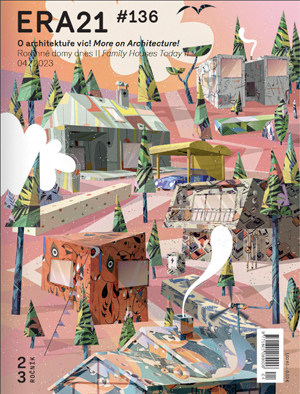
EditoRail: On the Rails » I’m writing this editorial – where else? – on a train, on my way to our Brno editorial office. Railways have been a constant in my life, largely thanks to my father’s former profession. Until the age of 26, I enjoyed the perk of “company travel,” crossing half of Europe by train, with a particular fondness for the Balkans. It was quite an adventure in those days. Today, though the free rides are a thing of the past, my passion for the railway endures, despite the occasional accidents and hours-long delays I have experienced over the years. While I’ve never done the exact math, I estimate I cover over 40,000 kilometers by rail each year. |
| news | ||
| completed project |
Prague Type. Dvorecký Bridge in Prague » The Dvorecký Bridge now connects Podolí and Zlíchov, significantly improving mobility in this part of Prague. Until now, the last connection between the right and left banks of the Vltava River south of the city center was the Vyšehrad Railway Bridge, located 1,800 meters from the new bridge. A distinctive feature of the new structure is its design, inspired by historical examples. The designers deliberately avoided structures that protrude above the bridge deck, such as pylons or upper arches. Instead, the bridge deck is supported by massive wall piers that are fully integrated with the load-bearing structure and, in their appearance, reference the traditional design of Prague’s bridges. |
|
| intro |
Cuts » The Railcuts (1985) series by Canadian photographer Edward Burtynsky presents a study of the radical yet precise intervention of engineering construction into the untamed environments of British Columbia. Instead of the romanticized panoramas found in the work of 19th-century photographers documenting the Canadian Pacific Railway, Burtynsky focuses on frontal, geometrically austere shots of blasted rock faces that had to make way for the tracks. In a fascinating way, he reveals the tectonics of a landscape transformed by human hands – exposed rock layers and the sharp lines of the cuts create a dynamic architecture that feels simultaneously monumental and claustrophobic. The photographs demonstrate how transport infrastructure becomes a permanent part of the Earth’s topography, where destruction paradoxically shifts into a new form of aesthetics. |
|
| interview |
Railways in the 21st Century: The Renaissance of a Transport Mode. Raphaël Ménard Interviewed by Filip Landa » Raphaël Ménard from the French studio AREP is a visionary in the field of sustainable transport infrastructure. In this interview for ERA21 magazine, he addresses a fundamental question: how can railways become a key tool for ecological transformation? What exactly does the concept of a “post-carbon station” entail, and how can traditional transport hubs be transformed into living, urban ecosystems? He illustrates AREP's design principles through examples such as the high-speed rail terminal in Jihlava, designed in collaboration with the Czech studio monom. |
|
| conception |
Landscape at Stake. The Podřipsko Region amid Infrastructure Transformation » The landscape of the northern Central Bohemian Region and the Podřipsko area has long been approaching the limits of what it can sustain. Intensive agriculture, sand extraction, landfills, logistics parks, and uncontrolled suburbanisation have transformed the region into a fragmented “dormitory for Prague”, with an overburdened transport network and low ecological stability. The area is now facing further large-scale infrastructure projects, including the Prague–Dresden high-speed railway with the Roudnice High-Speed Rail Terminal, the completion of the D0 Prague Ring Road, the expansion of the D8 motorway, and other transport developments. |
|
| essay |
Prague Hub » At first glance, the Prague railway node presents a complex network of tracks, stations, branch lines, passing tracks, freight terminals, and spur lines. Spanning nearly two centuries, its trajectory is closely intertwined with urban development, reflecting a mutual influence. What constitutes the historical evolution of Prague’s railway infrastructure, and what are its future prospects? |
|
| practice |
Between Prague and London. Railway Infrastructure in Projects by Boele Architects » In recent years, numerous design competitions related to the planned construction of high-speed rail lines have been announced in the Czech Republic. For some architectural firms, these competitions have served as an excellent springboard for establishing their own practices. Among the most successful of these teams is Boele Architects. |
|
| reflection |
Railway as a Second Chance » What could high-speed rail change in Ústí nad Labem? Why can’t the terminal alone save the city? The planned Prague–Ústí nad Labem–Dresden high-speed rail line is much more than a transport project for North Bohemia. It could provide fresh impetus for regenerating the regional capital’s city center, reconnect its divided neighborhoods, and support the region’s economic transformation. Equally, however, it could create new barriers and accelerate population loss. The outcome will depend on the quality of the terminal and related urban development projects, as well as the ability to sustain the agreed cooperation beyond a single electoral term. |
|
| completed project |
Gateway to the City. Jihlava City Transportation Terminal » The modernization project for Jihlava City railway station transforms an oversized and technically inadequate rail yard into the city's main transport hub, with a direct connection to Jihlava's historic center. The architectural concept deliberately downplays the utilitarian transport function in favor of a well-designed public space. The original station building from 1887 has been replaced by a new building consisting of two simple cubic volumes with brick cladding and granite plinths, housing facilities for passengers and staff. The buildings are unified by a prominent cantilevered roof with circular openings, which will also connect to the planned bus terminal in the future. The new track layout and the integration of rail and urban transport prepare the station for its future connection to the Prague–Brno high-speed rail line. |
|
| completed project |
The City Begins at the Station. Transformations in Railway Infrastructure » Railway stations shape our first impression and overall experience of a city, serving as both transport hubs and public gateways. As rail gains importance as a sustainable mode of transport, new projects are restoring historic and post-war buildings, connecting different modes of travel, and improving surrounding public space. Beyond modernising operations, they also reconsider how stations relate to their urban surroundings and how passengers move through them. Yet while the Czech Railway Administration focuses on major regional centres, less prominent station buildings and smaller railway structures often disappear without wider debate. Developments surrounding the railway should therefore be followed not only in relation to the preparation of high-speed rail lines, but also with regard to the cultural value, memory, and future character of the places they pass through. |
|
| idea |
Memory of the Railway Station » Initially embedded within the social milieu of the logistics landscape at Nordwestbahnhof, Vienna’s last operating inner-city cargo terminal, Tracing Spaces collected narratives and artefacts from the site's diverse history and made them accessible to a wider audience. Through a variety of exhibition formats and events, the project started indoors before soon expanding onto the brownfield, which is currently being demolished for the redevelopment of a monocultural housing neighborhood. This practice aims to reintegrate these narratives and artefacts as identity-forming markers in the newly emerging urban development area. In the long term, it seeks to establish the museum as a local cultural center in one of the historic warehouses on the site. |
|
| trends | ||
| appendix |






ERA21 vydává ERA Média, s. r. o. |
|
|
Phone: +420 530 500 801 E-mail: redakce@era21.cz |
|




|
WEBdesign Kangaroo group, a.s.
|


